
When we think of sustaining this overall homeworking provision… what do we mean?
Communications & Collaboration
With 53% of enterprises expecting to keep 10-25% of their workforce homeworking for the next 12 months, being able to make calls outside of your organisation will be necessary for all employees. If you took advantage of a free Microsoft Teams trial, then getting the most out of that application will be vital.
- Teams
- Direct2Teams – external call capabilities for Microsoft Teams
- MiFi
- Mobile
Connectivity
But addressing this challenge does require some planning and does depend on the building blocks that your organisation has in place already.
Providing enterprise-grade connectivity to employees’ homes is achievable for any organisation, for example:
- Using SD-WAN
- Extending your enterprise-level Local Area Network (LAN) and WiFi access to employee homes.
- Increasing centralised Internet bandwidth to meet the demand for additional remote users
- Enabling VPN features for existing firewalls
- Increasing licences features for existing VPN solutions
Extending existing enterprise wireless to employees homeworking
By using solutions such as Cisco Meraki, you can extend your enterprise-level WiFi to a location outside of your buildings. In this case, to employees working from home.
Connectivity
Security
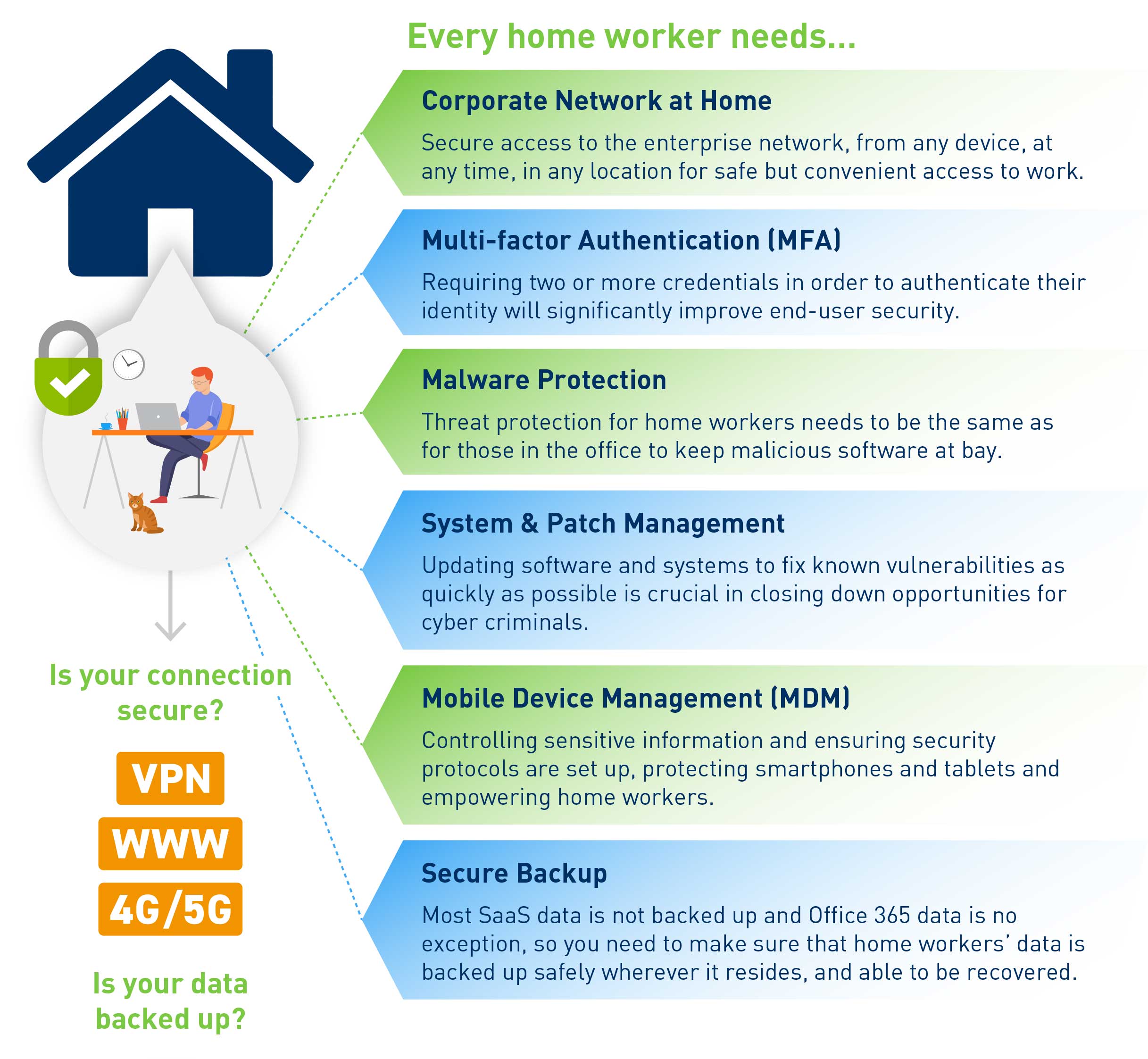
Long term, you will need to make some decisions about how your IT infrastructure will underpin your organisational demands. One in five organisations deployed new security tools during the lockdown period just to cope with the change to the working environment. Whether or not you chose to reinforce your security provision you will still need to assess what you have in place to ensure it is fit for purpose, not just for the next two months but the next two years and beyond.
Reviewing cloud service that can be deployed remotely, or remotely configured, will allow you much greater flexibility and control for future demands:
Palo Alto Virtual Firewalls
No need for any additional equipment, you can deploy enterprise-grade secure connectivity across public, private or hybrid cloud, where deploying hardware firewalls is difficult or impossible.
Cisco Umbrella
Protect your employees wherever they are by extending enterprise web filtering to their home. Protect them against phishing, malware, botnets, and other cybersecurity threats. If you are using Cisco Meraki WiFi already, Umbrella deploys instantly across a Meraki WiFi network to protect users from Internet threats with no added latency.
Make sure you are aware of you home working security essentials >>
Business Continuity (BC) and Planning
This virus may have placed unprecedented demands on organisations, but now we are in a position to assess our organisational response and contingency plans, so that processes and procedures can be updated.
Daisy’s BCaaS solution can flex with the demands of your business, regularly reviewing what is important, and closing gaps that could affect your recovery effort. The design and implementation result in an appropriate programme that reflects your current organisation and adapts as you grow.
Read more about how BCaaS can help you plan for the unforeseen >>
Business Continuity (BC) and Planning
Hardware
At the beginning of the lockdown period the demand for mobiles, tablet and laptops skyrocketed. No matter what tools, enterprise-level applications, connectivity and access your employees have been provided with, they will need a device that is suitable for the task at hand.
Preparing and evaluating employees’ roles and the devices they need must be a continuing process. Appraising these roles regularly will mean that you are in a better position to ensure that when people must work from home, they are suitably equipped.
Return of the Office
If you need more space to accommodate social distancing, serviced office space can be a great alternative to a long-term property commitment. Flexibility is paramount – your organisation may have discovered that it has more fallow office space than it thought and needs temporarily less space or a supple approach to making sure that you have the correct sized facilities for your short term needs.
Return of the Office
Assess
Whatever changes or new technology you have deployed will need to be reviewed:
- It was right for now – but is it suitable for six, 12 or 18 months from now?
- Our response was good but what could have been better?
- Employees could work from home but was it as effective as working from one of our own locations? If not, why not?
- Quickly deploying Teams was the right move – but are we really getting the most out of it?
- Our security posture was good pre-COVID – what does it look like now?
- Were our BC plans really up to scratch?
- Having purchased a significant number of laptops to accommodate home-working what do we do now? Does this become the standard device for the business and what does that mean?
- Congestion on our VPN meant employees had a varied experience depending on the time of day and number of users – what could we do better?
- How do we make the whole process faster?
These are just some examples of how seeking to improve can stimulate assessment of all your homeworking provisions.
Despite the relaxation of controls in movement and the reopening of many sectors, we are not out of the woods yet. The provision for localised lockdowns to address outbreaks in towns and cities up and down the UK means that even greater organisational flexibility will be required soon and beyond that, who knows?
That is the redefinition of normality – the unusual is here with us all for a while to come yet. Taking into consideration what we have discussed here might be the difference between organisational success and the unbearable alternative.
If you would like to speak to us to see how we can help your organisation prepare for now and the future, please get in touch today.